May
2026
IR Rubber and EUDR: Strategic Portfolio Expansion for Market Stability
The rubber industry is currently facing one of the most significant legislative changes in the history of the European Union. The EUDR regulation fundamentally alters the rules for placing products on the market, requiring companies to provide proof of the origin of raw materials. At BOGUMA, we view Isoprene Rubber (IR) as the key to maintaining production stability during this turbulent period. Introducing this material as an alternative eliminates the need for origin certificates and ensures continuity of supply, regardless of complex environmental requirements. Although natural rubber (NR) remains unsurpassed in many parameters, IR offers equally good performance, stability, and a lower administrative burden.
The Deforestation Regulation creates barriers primarily for Natural Rubber (NR), which originates from agricultural plantations. According to current information, the involvement of intermediaries in the certification and verification process is expected to increase its market price. However, fully synthetic IR rubber, by definition, is not subject to this legislation, saving both time and administrative costs. Our experts, led by Mr. Teodor Puha, Director of BOGUMA, have developed solutions in the form of new formulations that combine product quality with the preservation of all existing properties. This strategic change protects your business and supports sustainability goals without unnecessary bureaucracy. BOGUMA will, of course, continue to produce electrical insulating matting and electrical insulating blankets based on natural rubber for companies choosing to undergo the EUDR process.
Comprehensive Portfolio of Electrical Insulating Solutions: From Class 0 to Class 4
At BOGUMA, we are constantly working on the further development of all our product classes to cover a wide spectrum of needs in the energy and industrial sectors. Whether you choose traditional natural rubber from low-risk areas or our synthetic alternatives, we guarantee top-tier protection tailored to your specifications.
Here is an overview of available classes and their typical applications:
|
Product Type (DEK) |
Class |
Maximum Working Voltage (AC) |
Typical Use and Application |
|
DEK Class 0 |
Class 0 |
1,000 V |
Low-voltage installations, switchboards in administrative buildings, residential connections. |
|
DEK Class 1 |
Class 1 |
7,500 V |
New in our portfolio! Suitable for medium-duty industrial operations and service workshops. |
|
DEK Class 2 |
Class 2 |
17,000 V |
Industrial transformer stations, maintenance of distribution cabinets in factories. |
|
DEK Class 3 |
Class 3 |
26,500 V |
High-voltage nodes and critical infrastructure with high durability requirements. |
|
DEK Class 4 |
Class 4 |
36,000 V |
The highest level of protection for work on very high-voltage equipment. |
What does EUDR bring to the rubber industry? Key dates and obligations
The new EUDR regulation fundamentally changes how companies place products on the EU market. The primary objective of this legislation is the elimination of products contributing to deforestation or forest degradation worldwide. In our company, we closely monitor these changes as Natural Rubber (NR) is among the seven selected commodities under strict regulation. Every economic operator must prove that its raw materials do not originate from land deforested after December 31, 2020.
This process entails the following obligations and terms:
- Due Diligence Statement: Companies must submit a document confirming zero risk of deforestation before placing any product on the market.
- Due Diligence System (DDS): Includes information gathering, risk assessment, and risk mitigation measures.
- Traceability: Requires precise identification of origin down to the specific plot of land of production.
- Geolocation: The obligation to provide exact GPS coordinates of where the natural rubber (NR) was produced.
For companies using rubber compounds, this represents a massive increase in administrative workload related to supply chain verification. At BOGUMA, we prioritize responsible partner selection, and our NR suppliers originate exclusively from countries with a low risk of deforestation. We help our partners overcome these barriers by offering synthetic alternatives. Since the EUDR regulation mandates that these records be kept for at least five years, transitioning to materials free of this burden significantly simplifies your internal quality management and compliance.
Geolocation and Traceability: The Administrative Burden of Natural Rubber
Traceability of raw materials is the most complicated part of the new environmental rules for the rubber industry. BOGUMA identifies that when using Natural Rubber (NR), buyers must collect vast amounts of data from growers in tropical regions. Every shipment requires precise proof of non-interference with forests, which in practice means verification of satellite imagery and geolocation points. If a company fails to provide this data, it risks a halt in sales of its final products on the EU market.
A comparison of documentation requirements clearly shows the advantages of the synthetic path:
|
Documentation Requirement |
Natural Rubber (NR) |
Isoprene Rubber (IR) |
|
GPS coordinates of land |
Mandatory (Latitude and Longitude) |
Not required |
|
Production timestamp |
Mandatory for every batch |
Not required |
|
Proof of deforestation-free |
Requires satellite monitoring |
Not required |
|
Sanction risk (EUDR) |
High (up to 4% of turnover) |
Zero (not under regulation) |
At BOGUMA, we emphasize that the administrative burden of NR increases personnel costs in purchasing and quality departments. Synthetic Rubber (IR) is created through a controlled chemical process in industrial facilities, so it does not cause land-use change. By using IR, you completely eliminate the need to maintain a complex Due Diligence System (DDS) for this component. This strategic decision ensures smooth production without the threat of legislative blockades.
Risk Countries and Benchmarking: Where does legal NR import end?
The country assessment system, known as benchmarking, divides natural rubber (NR) producers into three risk levels: high, standard, and low. This represents a new level of responsibility for purchasing teams, but BOGUMA is prepared for this change. Our purchasing processes are set up so that we import raw materials exclusively from low-risk countries with clearly verified origins, thereby minimizing the impact of benchmarking on our customers. This approach allows us to avoid strict customs inspections and risks associated with imports from unstable regions.
In communication with suppliers, we constantly monitor the situation in Southeast Asia to guarantee that our natural compounds meet all EUDR environmental criteria. Parallel to this, we are expanding our offer with Isoprene Rubber (IR). It is produced in a controlled industrial environment, providing our partners with an additional layer of certainty – a stable product that is completely immune to potential sudden changes in global country risk assessments.
A New Chapter: IR Rubber Products as an Effective Alternative
In our production, Isoprene Rubber (IR) represents a full-fledged alternative to traditional natural rubber (NR) for certain products. It is a synthetic polymer whose molecular structure almost perfectly replicates the properties of natural rubber. Unlike rubber obtained from plantations, IR rubber is not subject to the strict requirements of the EUDR regulation. This means that when using it, we do not have to prove land geolocation or track harvest times in high-risk tropical areas. It is important to clarify that while IR almost perfectly mimics the structure of NR, each has its specific place in the industry depending on the final application and product requirements.
Our technical team highlights the following properties in particular:
- High Elasticity: The material exhibits excellent elasticity comparable to high-quality NR.
- Tensile Strength: Reaches the values necessary for demanding industrial seals and insulation.
- Fatigue Resistance: Ensures long life of components under dynamic stress.
The use of IR rubber allows BOGUMA to manufacture products with consistent quality without legislative barriers. This material facilitates the transition to ecologically safer business models as it completely eliminates the risk associated with deforestation. The customer thus receives a product with top technical parameters that is fully prepared for the post-EUDR era, fully certified according to IEC 61111:2009.
Price Stability and Supply Chain in the Post-December 2026 Era
The approaching deadline for full EUDR implementation in December 2026 (starting January 1, 2027) is causing concerns in the European market regarding the availability of certified Natural Rubber (NR). At BOGUMA, we expect that increased monitoring and administrative costs will lead to a price increase for this raw material, which will inevitably be reflected in product prices. We view Isoprene Rubber (IR) as a strategic tool for cost stabilization, as its price does not depend on tropical harvests or EUDR-related fees (primarily certificates, audits, geolocation verification, and increased administration).
The impact of new legislation on market stability is summarized below:
|
Stability Factor |
Natural Rubber (NR) |
Isoprene Rubber (IR) |
|
Raw material availability |
Possible risk of shortage due to checks |
High and predictable |
|
Price fluctuations |
Influenced by weather, politics, and certification |
Stable industrial prices |
|
Administrative costs |
High certification fees |
Zero (not subject to EUDR) |
|
Logistic barriers |
Risk of delays at EU borders |
Smooth delivery without obstacles |
We inform every customer that utilizing IR rubber facilitates our long-term production planning and ensures price stability for raw materials. Transitioning to IR-based products thus ensures not only technical quality but, above all, the economic security of your business in the post-EUDR era.
Reducing Carbon Footprint Without Deforestation Risk
Sustainability in industry today requires concrete steps that go beyond basic environmental declarations. At BOGUMA, we see Isoprene Rubber (IR) as an important pillar within our ESG strategy. Although it is a synthetic material, its key advantage lies in the complete elimination of risks associated with deforestation in tropical regions. By using IR, you guarantee that your products do not contribute to the destruction of rainforests in Southeast Asia or Africa. This ensures a clean environmental profile for your company and facilitates non-financial reporting.
We have prepared solutions that meet the strictest standards, such as IEC 61111:2009, without the need to track complicated land geolocations. The transition to synthetic materials reduces the administrative burden of the EUDR regulation while protecting natural ecosystems. Your production thus remains technically superior and ethically responsible toward the global environment.
Security of Supply for Critical Infrastructure
The stability of energy grids and industrial nodes depends on the reliability of protective elements subject to strict control. At BOGUMA, we realize that any violation of the EUDR regulation can lead to an immediate halt in sales and confiscation of goods. For state enterprises and strategic partners in transport or energy, IR rubber products act as an insurance policy. These materials guarantee continuity of maintenance and operation without the risk of a missing Due Diligence Statement paralyzing critical infrastructure.
Transitioning to BOGUMA solutions brings these strategic certainties:
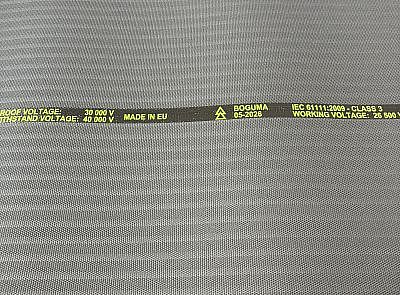
- Certification Support: As the material composition differs from natural rubber, these products require new certification. Our electro-insulating IR mats have successfully passed the IEC 61111:2009 certification.
- Portfolio Expansion: We have expanded our portfolio to include the new Class 1, providing our clients with a wider range of options.
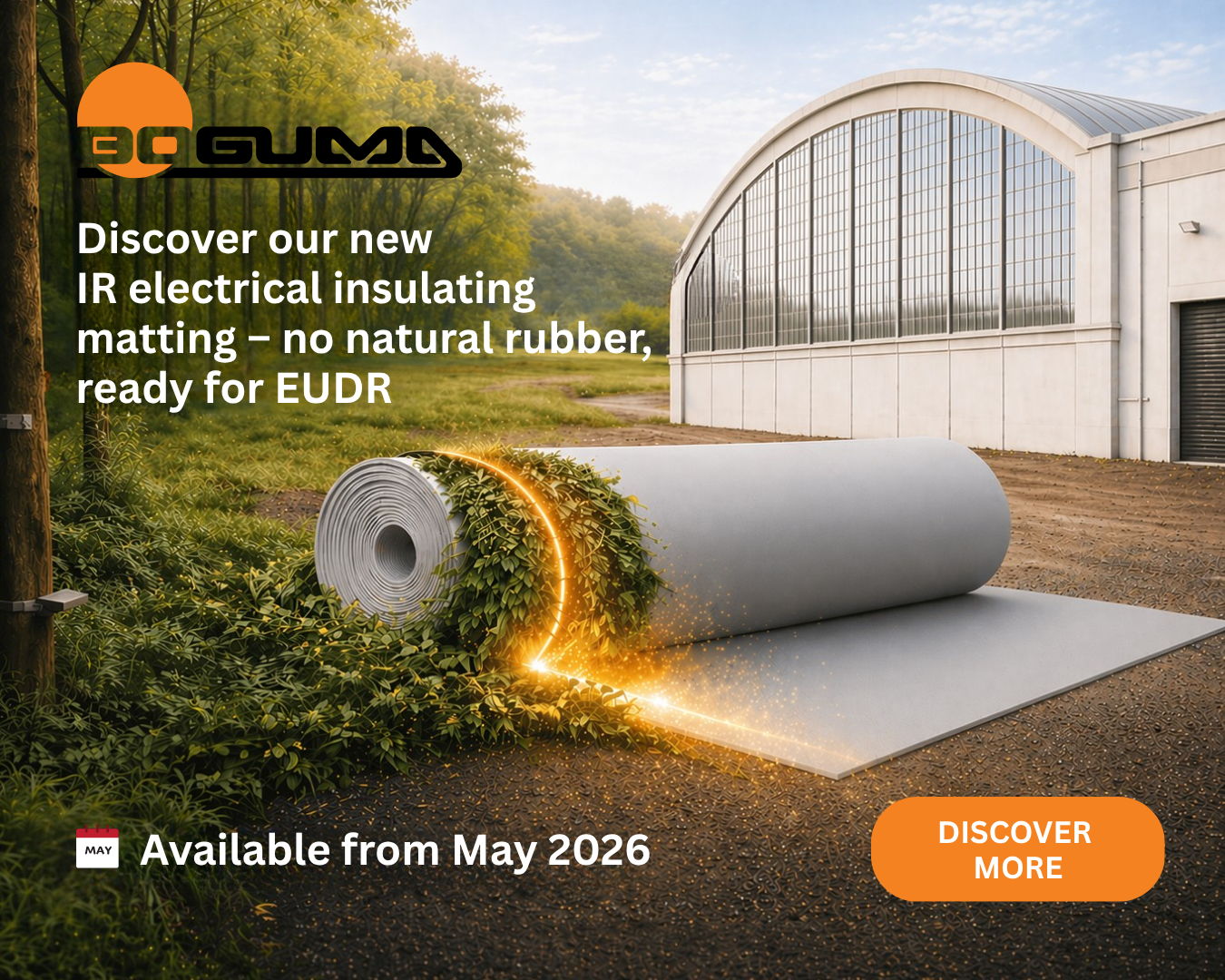
- Market Launch Schedule: The first production series is planned for May 2026. Due to high interest, we are currently accepting pre-orders to ensure priority stock allocation.
- Continuous Development: We are constantly working on the development of other classes and formulations to cover the full spectrum of industrial needs.
- Elimination of Sanctions: Using synthetics prevents fines up to 4% of annual turnover for non-compliance with EUDR.
- Immunity to Blockades: Your shipments will not get stuck at borders due to NR origin geolocation checks.
- Standard Compliance: Products fully comply with IEC 61111:2009 requirements for live working.
- Long-term Predictability: You avoid the global shortage of certified natural rubber on the European market.
Securing critical systems requires materials that meet technical parameters while being legally compliant. BOGUMA supplies electrical insulating matting and blankets that protect both worker health and business stability. The strategic choice of IR rubber removes uncertainty from future audits and allows you to focus fully on technological development without administrative barriers.
Frequently Asked Questions (FAQ): IR Rubber and EUDR Legislation
What exactly does the EUDR regulation mean for rubber product buyers?
The regulation mandates proof that products containing natural rubber (NR) did not cause deforestation. From December 30, 2026 (for large/medium enterprises) and June 30, 2027 (for micro/small enterprises), no NR product can be placed on the EU market without a valid Due Diligence Statement.
Why is IR rubber considered "safe" regarding EUDR?
IR rubber (Isoprene Rubber) is produced chemically in industrial facilities. Since it does not come from agricultural plantation production, it completely avoids the obligation to document land geolocation.
Are the mechanical properties of IR rubber comparable to Natural Rubber (NR)?
IR offers high purity and stability; however, in some extreme dynamic conditions, natural rubber remains irreplaceable. Our goal is to offer customers a choice based on their specific needs.
What is the main administrative advantage of switching to IR rubber?
Your company stops collecting GPS coordinates of land plots and tracking exact production times of raw materials. This step significantly reduces personnel costs associated with maintaining a Due Diligence System (DDS).
Are there sanctions for non-compliance with EUDR?
The regulation includes strict penalties, including product confiscation and temporary bans on placing products on the market. Financial fines in serious cases can reach up to 4% of the operator's annual EU turnover.
How will EUDR affect the price of Natural Rubber compared to IR?
We expect NR prices to rise due to monitoring, certification, and mandatory environmental audit costs. IR rubber offers a more stable price level as its processing is not subject to administrative traceability fees.
Do I still need to maintain a Due Diligence System for IR rubber?
Under EUDR legislation, this obligation does not apply to synthetic materials. Since IR is not on the list of regulated commodities, you do not need to fill out any statements in the EU system for it.
Is IR rubber suitable for all BOGUMA products?
he material is ideal for most products requiring the properties of natural rubber, such as insulating mats, seals, or certain extruded profiles. Our specialists will help you verify the suitability of this alternative for your specific technical requirements (noting that for some specific products, such as para rubber or abrasion-resistant compounds, NR cannot yet be replaced).
When is the best time to start the transition from NR to IR solutions?
Our company has committed to delivering a full-scale replacement for IR-based electro-insulating mats and sheeting by the end of 2026 at the latest. By this deadline, we will have complete certification ready for these products, consistent with the standards you have come to expect from our NR range. We will begin accepting pre-orders in May 2026, allowing our customers to familiarize themselves with the new materials and prepare their internal processes.
 International Standards for Electrical Insulating Protection: Technical Overview of IEC and ASTM Standards
 The Complete Guide to Electrical Insulating Blankets (EIP): Safety, Standards & Industrial Use